
Classic Kit: The Machete
Photos by Nathan Hindman and Ben Edmondson
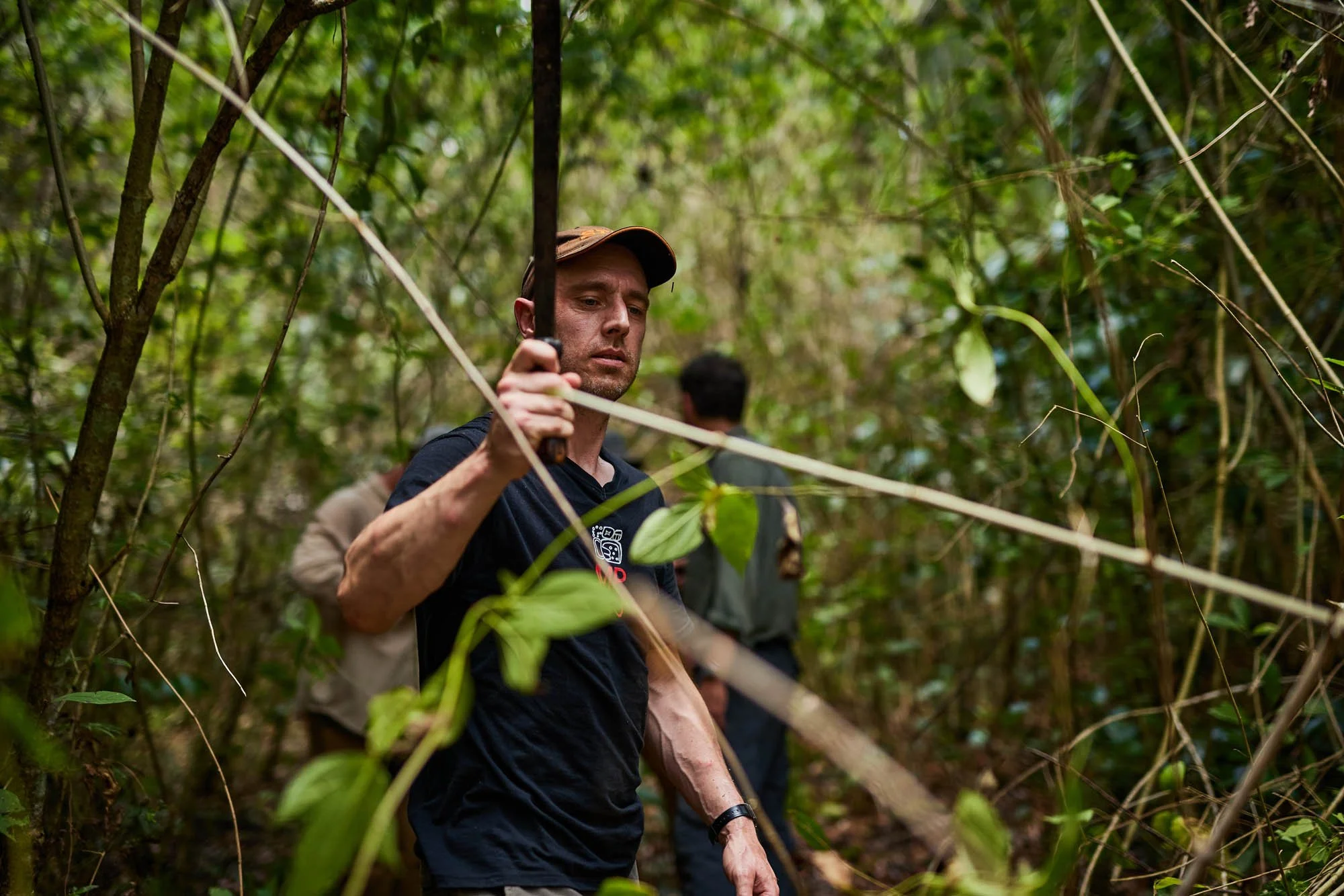
Will clearing a path in Belize with my grandfather’s machete
Originally published in Overland Journal
SUMMARY: Farm implement, bush tool, or weapon, this piece of kit sports 9,000 years of evolution.
It was in the Congo when Connie finally asked the question. This was after passing hundreds (literally) of people along the roads. In typical African fashion, the women were loaded up with firewood, water, and babies, often all three, in huge backbreaking loads. The men invariably sauntered along idly swinging a machete, nothing on their backs, and with little regard for the packhorse aspect of their partners.
“What…” Connie asked me one day after we passed a lady carrying a firewood stack twice as tall as she, while her husband (we supposed) followed along, requisite machete his only burden, “The machete is important so the man gets to carry it?” I had also been wondering this, so my answer included a lot of miles of off-hand contemplation and a fast growing sympathy for the females in central Africa: “No, the man carries the machete so the woman doesn’t kill him with it.”
There is classic kit, and then there is really classic kit; gear that has been with us since tools were first developed, and likely followed humans out of Africa. Certainly I’m not suggesting that ancient Homo sapiens used a Gerber machete to tame Europe and Asia, but a tool like it, probably made from bone or wood, or a combination of wood and stone, was certainly used, both as bush tool, and a weapon. In China, large jade knives have been found that look surprisingly akin to the modern machete. But it wasn’t until metal came on the scene some 7,000 years ago, that the true fore-runner of the machete we know today arrived.
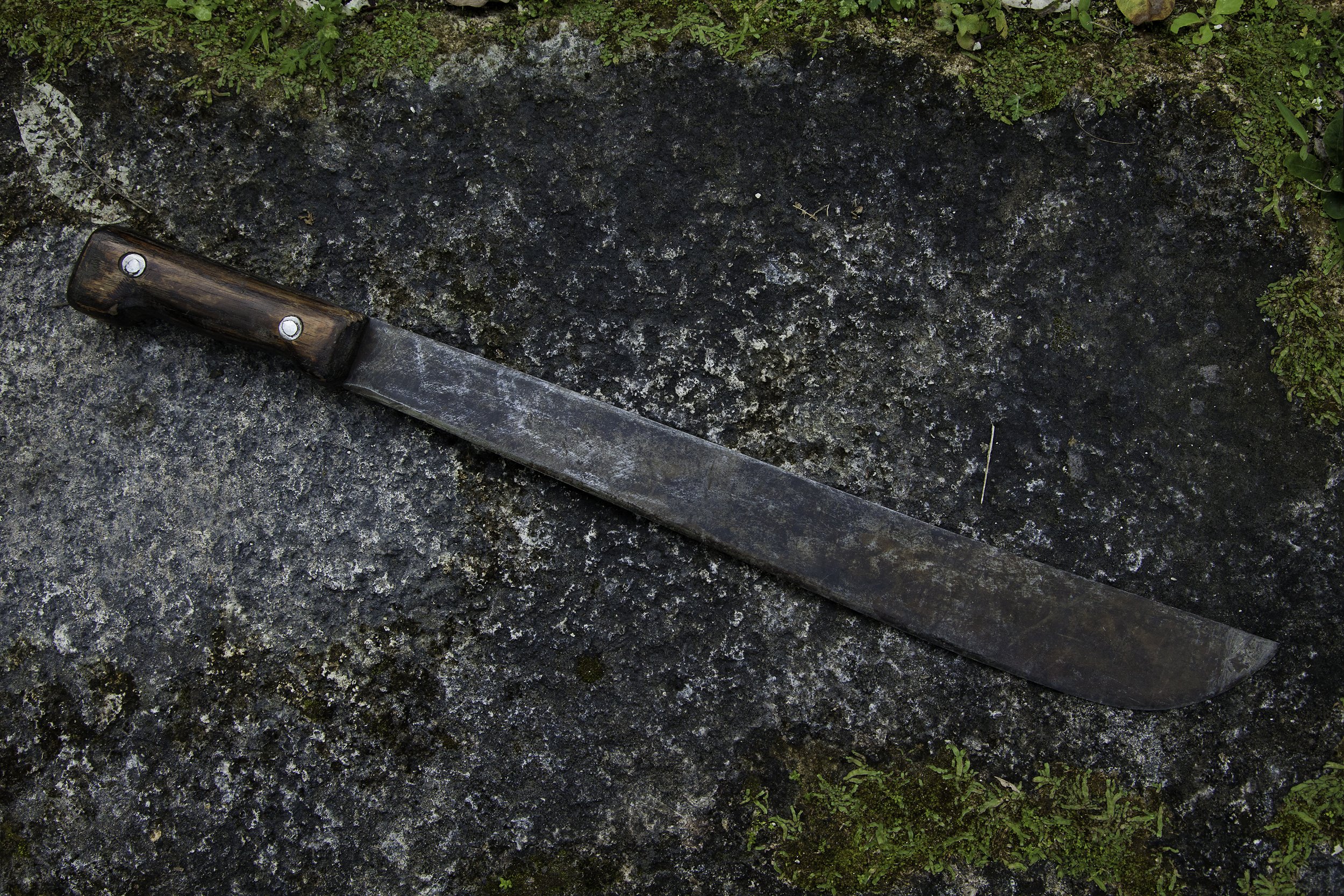
That same machete, an old British Ralph Martindale & Co. machete well used on many expeditions to Central America
Richard Burton, in The Book of the Sword, tries to persuade us that the metal ages should be combined, as the different metals (copper, brass, iron) were used in overlapping periods and concurrently in different parts of the world. So, in keeping with this, the next development in the history of the machete was likely development by the Greeks of the kopis (from ancient Greek “I cut”). This was a one-handed sword initially fashioned from copper or bronze, and later from steel, with a single edge and an upward curved belly. It was used both as a tool and a weapon, and doubtlessly saw use for animal slaughter and clearing brush; though the average farmer may not have been able to afford one. The butt of the hilt on a traditional kopis had the same knob on its underside that we see on modern machetes. It serves to brace the machete in the hand while allowing it to rotate around the little finger; increasing blade speed and hacking force, while reducing fatigue on the wrist.
The mass production of steel swords for the Roman Legion followed on from the Greeks. The gladius, or short sword carried by the Roman legionaries was about 22 inches long, very similar in size to the modern machete. Doubtless legionaries had to use their swords as tools as well, and clearing brush may well have been standard fare for the gladius. Once the Roman Empire fell, European sword development moved to larger hand-and-a-half and two-handed swords for use against armor, while in other regions like India and Persia, single-handed swords remained in use.
Around the fourteenth century the kukri appeared on the Indian subcontinent, and was, like the kopis, used as both a tool and a weapon. Today, known by many as the Gurkha knife, it remains largely unchanged from its 500-year-old ancestor, and has a distinctly forward curving blade. The name machete comes from matchet, the Spanish word for the agricultural brush-clearing tool used in Latin America. In the west, the machete found common use in both world wars for clearing jungle and as a weapon when needed. Both the U.S. and British armies issued machetes, and, in the U.S. case, the Woodsman’s Pal (see Classic Kit in Overland Journal Summer 2009). Many of the machetes issued were made in Sheffield England, which has been a cutlery-producing center for 400 years, and still has several companies that provide the world with machetes.
This brings us to modern times, where the machete now sees use throughout the world. Its forms are probably as diverse as the names currently in use for it: panga, barong, tapanga, cutlass, burriquito, daga, rozador, caluk, sable, pinuti, billhook, kukri, golok, and many more. Many of these names refer to a specific blade form—some older than what we call the machete—but all used as both a tool for cutting vegetation, and a weapon. A search at the British Library (the world’s largest library) provided very little on the background or history of the machete apart from recurring references to the 1994 genocide in Rwanda. There, a businessman allied with General Habyarimana, imported some 581,000 machetes for Hutu use in killing Tutsis—machetes were cheaper than guns. The tool was used in its more ominous weapon form, as the primary means used to dispatch some 800,000 people over 100 days.
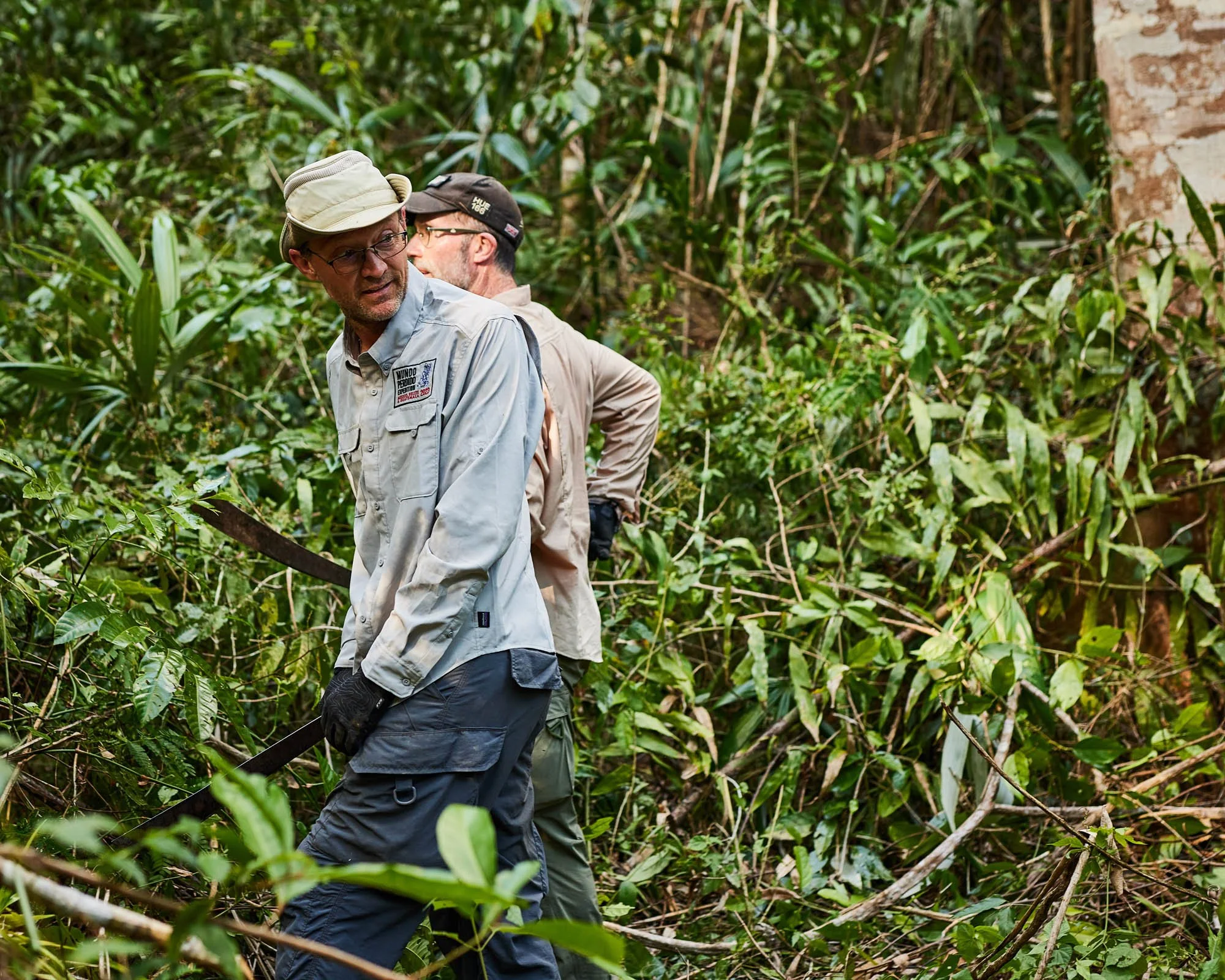
As I already mentioned, the machete comes in many forms. Usually it is made from low-carbon spring steel, which, while requiring more frequent field dressing, reduces the chance of chipping the blade. Remember this is a tool for a very abusive environment, and is used for hacking rather than sawing, so fancy stainless blades and high carbon steel blades have less of a place than something that is easily field dressed. European variants often referred to as fascina knives, tend to be thicker in the blade, more suitable for the hard, heavy trees of the continent. Similarly, thin blade machetes are common to the lower latitudes, as they are better suited for the softer woods of the tropics.
Most machetes have a full tang and handles of wood, plastic or composite with a lanyard hole in the base. The blades of most get deeper, or wider, down the length, providing weight and increasing the chopping effectiveness. Again, this is a knife used like an axe. The edge is mostly straight or concave, though some variants have a convex edge, giving a more axe-like action. Some styles, like the golok, originating in Indonesia, have a full primary grind providing a blade-deep taper that reduces the chances of getting lodged in green wood.
Machetes vary from 10 inches or less in length, to over 30 inches, and specialty types like the Woodsman’s Pal have integrated hooks and hand guards. Typically the spine is flat, though specialty manufacturers like Gerber make ‘survival’ machetes with saw teeth on the spine. The point can vary widely, from a golok style with a squared off end, to a billhook style with a downward hook at the point. Variations are only limited by the unlimited uses for the tool. The Ralph Martindale & Co. Ltd of Sheffield divides their blade styles up by region of the world. For Latin America and the Caribbean alone, they have 45 blade patterns, many denoted by such catchy names as 23W-510-01 (20 inch blade with no fullers in a very recognizable machete shape). Many are for very specific uses like sugar cane or green wood.
As a trusty sidekick on any overland expedition, especially those to jungle areas, the machete has many uses, but be wary handing one off to a female traveling companion lest her sympathies lie with the women of Africa.